Ke Ma, Ziyi Wu & Weixuan Nie,SCIENCE CHINA Chemistry Accepted
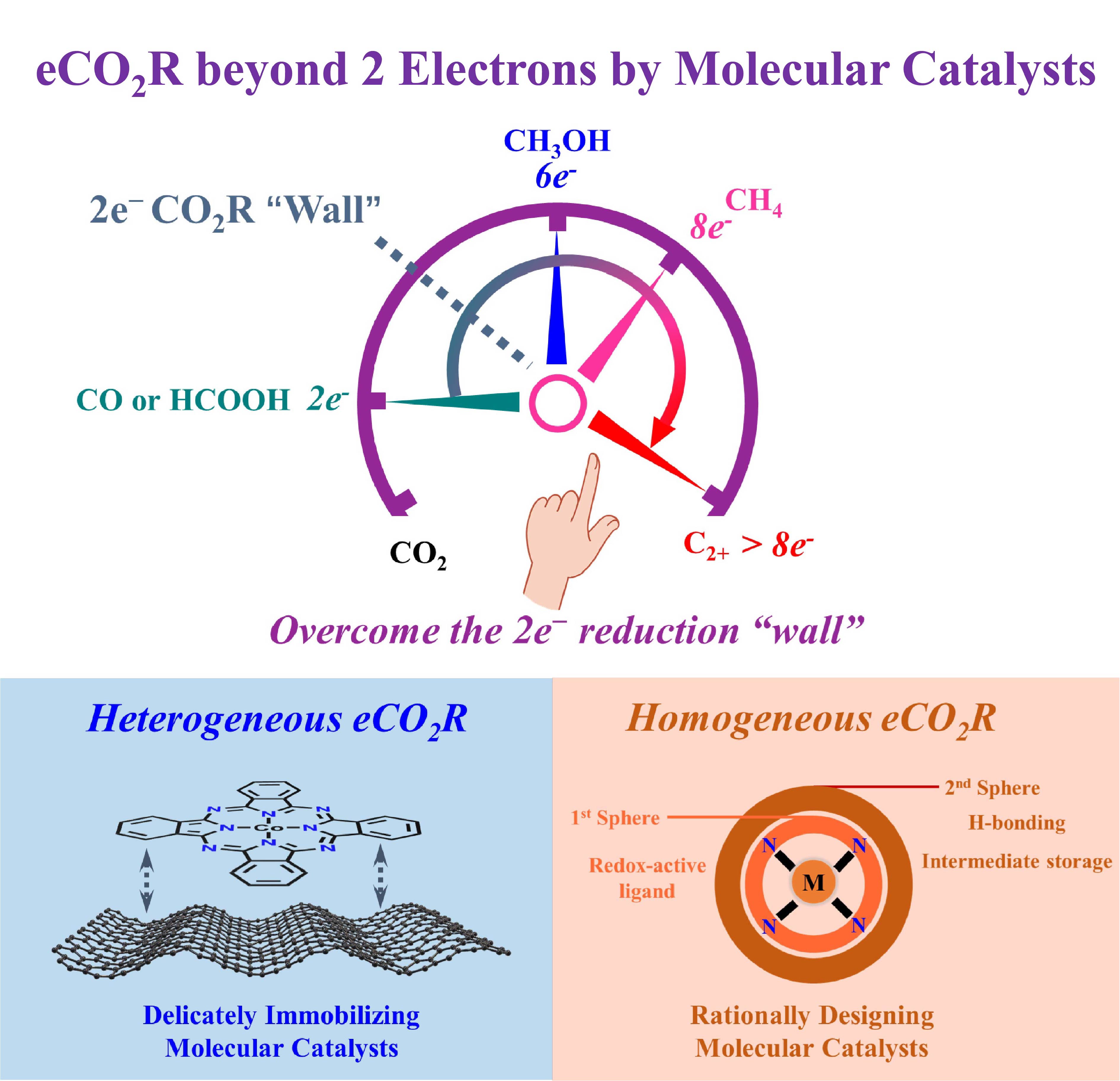
Electrocatalytic CO2 reduction (eCO2R) powered by renewable electricity offers a sustainable pathway to convert waste CO2 into energy-dense fuels and value-added chemical feedstocks. Compared to widely studied solid-state catalysts, molecular cat-alysts exhibit desirable selectivity towards a single product (e.g., CO or HCOOH) due to their better-defined and tunable mo-lecular catalytic sites for eCO2R. However, selective production of >2e− reduced products, such as formaldehyde (H2CO), methanol (CH3OH), methane (CH4), and even multi-carbon (C2+) products, remains a formidable challenge, intrinsically lim-ited by a trade-off between M–CO adsorption and M–CO activation abilities of free-standing molecular catalysts. This review examines recent advances in molecular eCO2R beyond two electrons, focusing on two divergent yet complementary strategies: (i) immobilizing molecular catalysts on conductive supports for heterogeneous eCO2R; (ii) rationally designing molecular structures for homogeneous eCO2R. For heterogeneous eCO2R, we highlight how catalyst-support interactions, strain engi-neering, and microenvironment modulation optimize M–CO binding energies for multiple-electron (>2e−) eCO2R by typical cobalt phthalocyanine (CoPc) derivatives, metal porphyrins, metal corroles, etc supported on carbon nanotubes. For homoge-neous eCO2R, we provide an overview of novel ligand-assisted catalytic pathways and the rational engineering of secondary coordination environments to overcome the 2e− reduction “wall” using a series of rhenium tricarbonyl complexes, iron porphy-rins, etc. In the end, outlooks for future directions in this field are also proposed, including expanding molecular design beyond traditional scaffolds, innovating efficient proton/electron-transfer approaches, and integrating electrocatalysis with chemi-cal/thermal catalysis to bridge the gap between laboratory discovery and industrial demands.